
7 Tips to Choose the Best Mineral Oil Based Defoamer?
Foam can look harmless, yet it may slow filtration, distort coating weight, and leave pinholes on finished surfaces. In a mixing tank, a thin foam layer can quickly become a costly production problem. Choosing the right Mineral Oil Based Defoamer requires more than comparing price per kilogram.
Industry reports show why this decision deserves careful attention. MarketsandMarkets’ Defoamers Market report identifies water treatment, paints and coatings, pulp and paper, and food processing as important application sectors. Grand View Research also reports continued growth in the global antifoaming agents market, supported by higher process efficiency requirements. These reports indicate rising demand, but they do not replace plant-level testing. Product performance changes with temperature, shear, pH, solids, and residence time.
This guide presents seven practical tips for selecting a suitable Mineral Oil Based Defoamer. The focus includes compatibility, dosage, dispersion, storage stability, regulatory documentation, and total operating cost. Small details matter. A product that performs well at 0.05% may create defects at 0.20%. A supplier’s technical data sheet is useful, but application trials remain essential. That point is easy to overlook.
The recommendations draw on common industrial evaluation practices and supplier documentation. They also recognize an uncomfortable truth: no universal defoamer works perfectly across every formulation. Readers should compare laboratory results with production conditions, including foam height, collapse time, surface appearance, and downstream defects. Keep records. Recheck assumptions. A reliable choice is not merely the fastest foam killer; it is the formulation that delivers stable control without harming the final process.
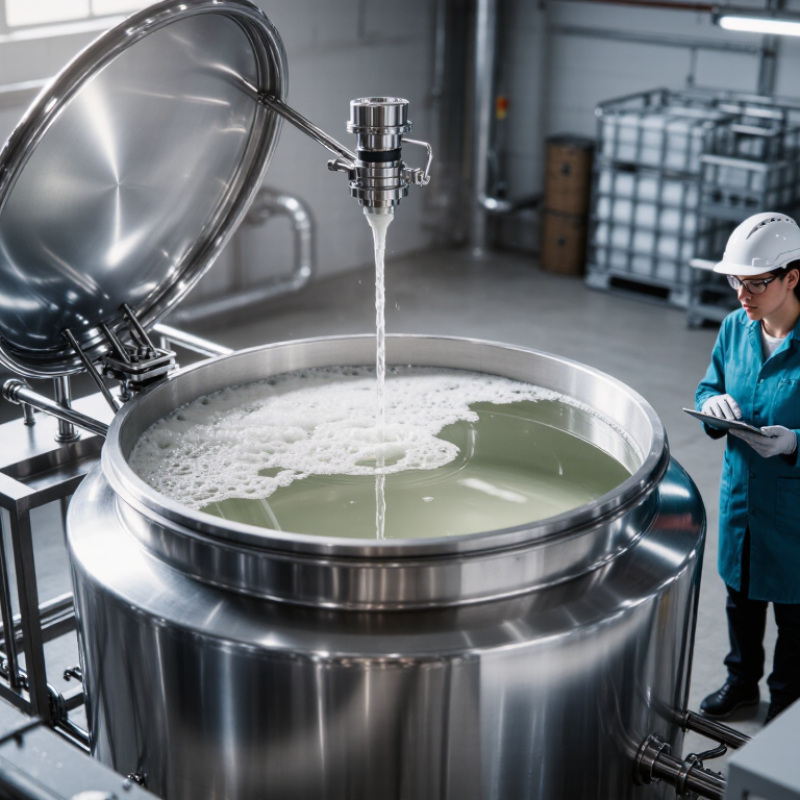
What Is a Mineral Oil-Based Defoamer and How Does It Work?
A mineral oil-based defoamer is a liquid additive that controls unwanted foam in coatings, wastewater treatment, adhesives, inks, and process fluids. Its mineral oil carrier spreads across foam films without dissolving completely in the surrounding water. Hydrophobic particles, waxes, or surfactants may strengthen this action.
The mechanism is physical. When the defoamer reaches a foam bubble, it weakens the thin liquid film. The film drains faster, ruptures, and allows nearby bubbles to merge. Lower surface tension helps the oil enter unstable areas. Proper dispersion matters, however. A poorly distributed defoamer may create oily spots or leave foam untouched.
Choose a product after checking the process temperature, pH, shear, and viscosity. A small jar test can reveal incompatibility before production begins. Add measured doses to a sample, then observe foam height after mixing and resting. Too little product fails. Too much may cause craters, fisheyes, or coating defects. I have found that fast knockdown is not always better; persistent control can matter more during storage and pumping. Mineral oil quality also matters, especially when odor, color, or regulatory requirements are strict. One test is rarely enough. Repeat it under real operating conditions.
Identify the Foam Source and Key Processing Conditions
Choosing a mineral oil based defoamer starts with identifying the foam source, not increasing dosage. In plant trials, I have seen identical foam appear for different reasons. Air entrainment, surfactants, proteins, and fine particles can all change foam behavior. A foam sample should be observed before treatment. Is it sticky, creamy, or filled with large bubbles? Does it collapse quickly after stirring? These details reveal useful clues.
Record the key processing conditions during foaming. Note temperature, pH, mixing speed, pressure, solids content, and residence time. High shear may create smaller bubbles and require faster defoamer spreading. Warm systems can reduce viscosity but may also increase foam activity. Surfactant-rich liquids often need stronger compatibility testing. Test the defoamer in the actual process liquid, not only in clean water. Small laboratory jars are helpful, but they cannot reproduce every production condition.
Apply several low dosages and compare knockdown speed, persistence, and surface defects. Check whether the mineral oil defoamer causes haze, craters, deposits, or filter blockage. I once selected a fast-acting product that performed poorly after overnight storage. The short test was too optimistic. A longer observation would have exposed the problem earlier. Keep records for each trial, including mixing time and temperature. The best choice is usually the lowest effective dosage that remains stable under real operating stress. Even then, one more production-scale check is wise.
Evaluate Defoaming Performance and Product Compatibility
Choosing a mineral oil based defoamer starts with the foam problem, not the product label. Watch the foam source. Record temperature, mixing speed, viscosity, and air intake during production. These details help you compare performance under realistic conditions. A quick jar test can reveal knockdown speed, persistence, and surface defects. However, a jar test is only a screening tool. I have seen strong laboratory results fail at full scale because shear conditions changed.
Test at the lowest practical dosage, then increase it in controlled steps. Measure collapse time, residual foam, crater formation, and clarity after processing. Do not judge performance by instant knockdown alone. Some defoamers remove foam quickly but create oily spots or poor surface appearance later. Check compatibility with the base oil, resin, solvent, pigment, and additives. Look for separation, haze, viscosity drift, and sediment after storage. Use heat-aging and freeze-thaw checks when the formulation faces temperature changes.
Application method matters. Compare pre-dilution, direct addition, and late-stage dosing if your process allows. Small differences in addition point can change dispersion and final foam control. Review safety data, handling instructions, and batch consistency with the supplier. Ask for technical data, but verify it in your own formulation. Keep written trial records, including dosage, mixing energy, and visual observations. One overlooked issue is overuse. Excess defoamer may reduce coating quality or interfere with later processing. That trade-off deserves another trial.
Check Safety, Regulatory, and Environmental Requirements
7 Tips to Choose the Best Mineral Oil Based Defoamer?
A mineral oil based defoamer should arrive with a current Safety Data Sheet (SDS). Check its composition, flash point, handling guidance, and storage temperature. Do not rely on the product name alone. Ask whether the formulation contains hazardous solvents, volatile components, or substances restricted in your market. A clear technical data sheet should also explain dosage, compatibility, and disposal procedures.
Regulatory fit requires careful checking. Confirm whether the defoamer is suitable for your application, such as coatings, wastewater treatment, paper processing, or food-related production. Food-contact use needs specific documentation, not verbal assurance. Request certificates, declarations, and batch traceability records. Requirements can differ between countries and industries. Local review matters.
Environmental performance deserves equal attention. Examine aquatic toxicity data, biodegradability information, and the behavior of residual oil in wastewater. A product that controls foam quickly may still create separation problems downstream. Run a small trial under actual temperature, pH, and shear conditions. Measure foam reduction, surface defects, filter loading, and sludge changes. Less is often better. However, I would not assume the lowest dosage is automatically safest. Supplier documents may be incomplete, and test results can vary between batches. Record every observation before approving long-term use.
Conduct Trials and Select the Most Cost-Effective Option
Mineral oil based defoamers can appear inexpensive, yet purchase price rarely shows the full cost. The real measure is cost per treated tonne. FAO’s FAOSTAT Forestry Production and Trade database reports global paper and paperboard production above 400 million tonnes in recent years. At this scale, a small dosage error can create substantial waste. A controlled plant trial is essential.
Tip 1: Test under real process conditions. Match temperature, pH, agitation, solids, and residence time. Compare a control with three dosage levels. Record foam height, collapse time, product defects, and deposit formation. Use the same sampling method each time. One trial can mislead.
Tip 2: Calculate total operating cost, not price per kilogram. Include dosage, downtime, cleaning, rejected material, and wastewater treatment. For example, a product costing 20% more may still save money if it works at half the dosage. Industry testing should also include storage stability and compatibility with coatings or sizing chemicals. ASTM D892 can support laboratory foam comparisons, but plant performance remains decisive.
Tip 3: Repeat the trial across shifts and raw-material changes. Mineral oil defoamers may behave differently with recycled fibers, higher temperatures, or changing water hardness. Document every result. A practical scorecard helps procurement and production teams agree. My own caution is simple: the cheapest trial result is not always the most reliable one. Review the weak data before approving a long-term supply decision.
7 Tips to Choose the Best Mineral Oil Based Defoamer? - Conduct Trials and Select the Most Cost-Effective Option
| Tip | Evaluation Dimension | Recommended Trial Method | Candidate A Mineral Oil / Hydrophobic Filler | Candidate B Mineral Oil / Nonionic Surfactant | Candidate C Low-Viscosity Mineral Oil | Candidate D High-Viscosity Mineral Oil | Selection Guidance |
|---|---|---|---|---|---|---|---|
| 1 | Check compatibility with the formulation | Mix each defoamer into the complete coating and inspect for separation, oil droplets, craters, haze, or viscosity drift after 24 hours. | No separation Viscosity change: +1.8% | Slight haze Viscosity change: +3.6% | No separation Viscosity change: +0.9% | Visible surface oil Viscosity change: +4.8% | Prefer a product that remains uniformly dispersed and does not change the coating’s appearance or rheology. |
| 2 | Establish the effective dosage range | Screen at 0.10%, 0.20%, 0.30%, and 0.50% by total formulation weight. Record foam reduction and surface quality at each level. | Effective at 0.30% Overdose risk above 0.50% | Effective at 0.20% Broad dosage window | Effective at 0.18% Broad dosage window | Effective at 0.30% Slow dispersion below 0.20% | Use the lowest dosage that controls foam without creating surface defects or reducing coating performance. |
| 3 | Measure initial foam knockdown | Use a calibrated high-speed disperser at 2,000 rpm for 60 seconds. Measure foam height immediately after mixing. | Foam height: 18 mm | Foam height: 12 mm | Foam height: 9 mm | Foam height: 15 mm | Lower foam height indicates stronger immediate foam knockdown under the selected laboratory conditions. |
| 4 | Evaluate foam persistence | Measure foam height after 1 minute and 10 minutes of standing at 25 °C. Repeat the test three times. | 1 min: 10 mm 10 min: 4 mm | 1 min: 7 mm 10 min: 2 mm | 1 min: 4 mm 10 min: 1 mm | 1 min: 8 mm 10 min: 3 mm | Prioritize low residual foam when the process includes recirculation, filling, spraying, or vacuum deaeration. |
| 5 | Verify final film appearance | Apply a wet film at 100 µm, dry for 24 hours, and inspect gloss, cratering, orange peel, and surface uniformity. | 60° gloss: 72 GU Minor orange peel | 60° gloss: 69 GU No visible craters | 60° gloss: 74 GU Smooth surface | 60° gloss: 65 GU Two small craters | Choose the candidate that controls foam while preserving the required gloss and film uniformity. |
| 6 | Test process and storage stability | Compare viscosity, appearance, and foam control after 24 hours, 7 days at 25 °C, and 7 days at 40 °C. | Stable at 25 °C Slight settling at 40 °C | Stable at 25 °C Stable at 40 °C | Stable at 25 °C Stable at 40 °C | Settling after 7 days at 40 °C | Reject products that require frequent agitation or lose performance during normal storage and production conditions. |
| 7 | Compare total cost, not only price per kilogram | Calculate cost using the minimum effective dosage: material cost × dosage × 1,000 kg of finished formulation. | Material cost: $2.80/kg Dosage: 0.30% Cost: $8.40/metric ton | Material cost: $4.10/kg Dosage: 0.20% Cost: $8.20/metric ton | Material cost: $3.30/kg Dosage: 0.18% Cost: $5.94/metric ton | Material cost: $5.20/kg Dosage: 0.30% Cost: $15.60/metric ton | Candidate C offers the lowest calculated use cost and the strongest overall screening balance. Confirm with a production trial before approval. |
