
10 Tips for Buying Plastic Utensils in Bulk
Buying Plastic Utensils in bulk looks simple until one rushed order fills a storeroom with unsuitable stock. Forks may snap under firm foods. Spoons may warp beside hot soup. Clear packaging can also hide inconsistent sizing, weak seams, or unclear material information. This guide offers ten practical checks for comparing suppliers, materials, pack sizes, certifications, storage needs, and delivered costs. The aim is not merely to find the lowest unit price. It is to reduce waste, service problems, and unpleasant surprises.
The OECD’s Global Plastics Outlook reports that global plastic waste reached 353 million tonnes in 2019, while only 9% was ultimately recycled. That figure deserves attention when planning a large purchase. The United Nations Environment Programme’s 2023 Turning off the Tap report says plastic pollution could be reduced by 80% by 2040 through reuse, better design, recycling, and responsible policy. These reports do not make every plastic product unacceptable. They do make careless buying harder to defend. Marcus Eriksen, a marine plastic researcher and co-founder of 5 Gyres, has warned, “We can’t recycle our way out of plastic pollution.”
A reliable bulk decision starts with the actual serving environment. Measure the bowl depth. Test the utensil with hot and cold foods. Ask for samples before approving thousands of pieces. Check whether the supplier provides material details, food-contact documentation, and consistent case counts. Compare the full delivered cost, including freight, storage, damage, and disposal. Sometimes the greener option costs more upfront. Sometimes it simply prevents another order. The uncomfortable truth is that even careful buyers can overlook transport emissions or overestimate demand. That is why these ten tips focus on evidence, practical testing, and decisions that remain defensible after delivery.
Define Your Bulk Plastic Utensil Requirements
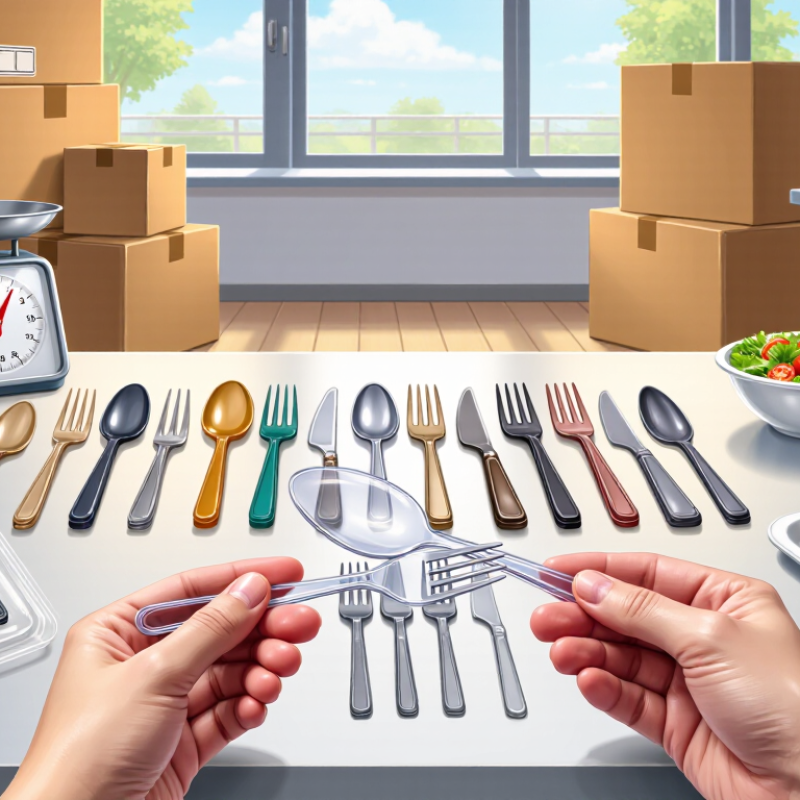
Before requesting a bulk quote, define how the plastic utensils will actually be used. A catering team needs different specifications from a school cafeteria or a takeaway kitchen. Record the expected meals per day, service period, utensil types, and required quantities. Include forks, spoons, knives, stirrers, and serving pieces separately. Small omissions can distort the final order.
Material selection should match temperature, food type, and handling conditions. For hot soup, check heat resistance and grip comfort. For oily foods, review material compatibility and surface strength. Food-contact documentation, safety test reports, and manufacturing details should be requested from the supplier. Requirements may differ by destination, so verify applicable standards before placing an order. Clear evidence is more useful than a confident sales promise.
Measure storage space, carton dimensions, and delivery frequency before choosing a package size. A warehouse shelf may hold fewer cartons than expected. My first estimate was too neat, and it ignored damaged pieces and seasonal demand. Add a practical reserve, but avoid buying several years of stock. Samples should be tested with real foods, wet hands, and normal serving pressure. Ask staff for feedback. Their comments often reveal sharp edges, weak handles, or uncomfortable sizes that a spreadsheet misses.
Compare Materials, Sizes, Designs, and Intended Uses
10 Tips for Buying Plastic Utensils in Bulk
Compare polypropylene, polystyrene, and recycled-content plastics before placing a large order. Polypropylene handles warm foods better, while polystyrene suits lighter, short-term service. Ask for food-contact documentation and temperature guidance from the supplier. Do not rely on appearance alone. Request samples, then test them with soup, salad dressing, and chilled desserts. Check flexibility, odor, cracking, and staining. Test a sample. I once chose a rigid spoon that looked professional but snapped against frozen dessert. That mistake increased waste and labor.
Measure the serving environment carefully. Match fork length and spoon depth to the meal style. Choose smaller pieces for tasting portions and larger tools for buffets. Check cup, container, and dispenser compatibility before ordering. Consider smooth edges, grip shape, and stackability for busy staff. A textured handle may improve control, but it can collect residue if poorly molded. Review color and transparency too. Clear utensils reveal cleanliness, while darker colors can hide food stains. Measure twice.
Design should follow intended use, not only unit price. Select sturdy utensils for dense foods and lighter options for brief events. Confirm whether the material tolerates refrigeration, reheating, or outdoor heat. Avoid mixing several sizes unless storage space allows it. Estimate daily consumption, storage humidity, and delivery timing before buying cartons. A low price may become expensive when damaged pieces fill the box. Start smaller. Recheck supplier specifications, packaging counts, and replacement terms before committing to bulk quantities.
Evaluate Supplier Quality, Safety Standards, and Certifications
When buying plastic utensils in bulk, supplier quality deserves more than a polished catalog. Request production samples from the exact factory line. Check edges, handles, seams, and surface smoothness by hand. Small cracks can appear after washing or stacking. Ask for the resin type and additives used in each item. Details matter.
Safety documents should match the product, material, and destination market. Review food-contact test reports, migration results, and restricted-substance declarations. Confirm the laboratory’s accreditation and test date. A certificate with no product scope is weak evidence. Verify its reference number directly with the issuing organization when possible. Do not rely on a logo alone. It happens often.
I also inspect batch records, packaging controls, and traceability procedures. The supplier should identify raw-material lots and production dates. During one review, the samples passed inspection, but carton dust showed poor storage control. That finding changed the purchase decision. I had focused too heavily on certificates. A factory audit, even a remote one, can reveal cleaning routines, worker training, and inspection frequency. Ask how rejected utensils are isolated. Request corrective-action records instead of accepting vague promises. A low price is not useful if quality changes between shipments.
| Tip | Evaluation Dimension | What to Confirm | Recommended Evidence or Test | Why It Matters |
|---|---|---|---|---|
| 1Identify the resin | Material composition | Require the exact food-contact plastic, such as polypropylene (PP), polyethylene (PE), polystyrene (PS), or polyethylene terephthalate (PET), rather than accepting “food-grade plastic” as the only description. | Request a material specification sheet, resin declaration, and batch or lot traceability information. | Different plastics have different heat resistance, chemical resistance, stiffness, and regulatory conditions of use. |
| 2Check food-contact compliance | Safety standards | Match the product to the destination market’s applicable rules. Common frameworks include United States FDA food-contact requirements, European Union Regulation (EC) No. 1935/2004, and EU plastics requirements under Regulation (EU) No. 10/2011. | Obtain a current declaration of compliance or supplier compliance statement that identifies the product, material, intended food types, and conditions of use. | Food-contact compliance depends on the specific material, additives, food type, temperature, and duration of contact. |
| 3Verify migration testing | Chemical migration control | Confirm that testing covers overall migration and relevant specific substances under conditions representing the intended use. | Review an independent laboratory report showing test methods, simulants, time, temperature, sample identification, and results. Avoid reports with missing product or batch details. | Migration testing helps demonstrate that substances do not transfer into food above applicable legal limits during foreseeable use. |
| 4Review temperature limits | Thermal performance | Define whether the utensil will contact hot food, boiling liquids, microwaves, freezers, or commercial dishwashers. Do not assume all plastic utensils tolerate high heat. | Request documented maximum and minimum use temperatures, heat-distortion data where relevant, and written restrictions against unsuitable uses. | Excessive heat can cause warping, loss of strength, or increased migration, especially when the plastic is not designed for the application. |
| 5Assess mechanical quality | Strength and durability | Inspect fork tines, spoon bowls, knife edges, handles, snap points, flash, cracks, sharp edges, and deformation after normal handling. | Use pre-shipment samples and define acceptance criteria for breakage, dimensional tolerance, visible defects, and load performance. | Consistent dimensions and adequate strength reduce user injury risks, product waste, and complaints during bulk distribution. |
| 6Confirm manufacturing controls | Supplier quality management | Evaluate documented controls for incoming resin, production parameters, cleaning, foreign-material prevention, rework, nonconforming goods, and final inspection. | Request an audit summary or quality manual, process-control records, corrective-action records, and a sample inspection plan. | Reliable procedures help maintain consistent quality across large production runs instead of relying only on final visual inspection. |
| 7Check hygiene and traceability | Sanitation and batch control | Confirm that finished utensils are protected from dust, moisture, pests, chemicals, and other contamination during production, packing, and storage. | Require lot codes, production dates, packaging specifications, sanitation procedures, and a documented recall or withdrawal process. | Traceability allows affected batches to be identified quickly if a defect, contamination issue, or compliance concern is discovered. |
| 8Validate certifications | Certification authenticity | Distinguish between a management-system certificate, a laboratory test report, and a product-specific food-contact declaration. A general certificate does not automatically prove utensil compliance. | Check certificate scope, issuing organization, certificate number, validity dates, covered site, and covered product category. Verify details with the issuing body when possible. | Accurate verification prevents outdated, altered, or irrelevant documents from being used as proof of product safety. |
| 9Inspect packaging and logistics | Protection during shipping | Specify inner bags, cartons, palletization, moisture protection, carton strength, quantity per carton, and storage conditions. | Approve a packaging specification and conduct a pre-shipment inspection for count accuracy, cleanliness, crushed cartons, odor, damage, and label information. | Clean, stable packaging reduces contamination, breakage, quantity errors, and damage caused by transport or warehouse handling. |
| 10Test a representative bulk sample | Pre-purchase verification | Before placing a large order, compare production samples with the approved specification for material, color, dimensions, weight, function, packaging, and markings. | Use a documented sampling plan and retain reference samples. For higher-risk applications, arrange independent inspection or laboratory testing before shipment. | Sampling provides practical evidence that the delivered production lot matches the documents and approved sample. |
Procurement note: Regulatory requirements vary by country and intended use. Obtain product-specific documentation for the market where the utensils will be sold or used, and verify that test conditions match the actual food, temperature, and contact duration.
Calculate Total Costs, Order Quantities, and Storage Needs
Buying plastic utensils in bulk starts with the full landed cost, not the carton price. Tip 1: Record the unit price, freight, taxes, and receiving fees. Tip 2: Add a 5–10% allowance for damaged or misplaced pieces. Tip 3: Compare cost per usable utensil, not cost per case. Tip 4: Request samples and count each pack by hand. Small errors become expensive quickly. In my purchasing checks, freight has sometimes changed the cheapest quote.
Tip 5: Estimate weekly consumption from invoices, event schedules, and seasonal demand. Tip 6: Multiply average weekly use by lead time. Tip 7: Add safety stock for delays, but question the percentage. A simple formula is: order quantity = expected use during lead time + safety stock − current inventory. The U.S. Environmental Protection Agency reported 14.5 million tons of plastic containers and packaging generated in 2018, with only 16.4% recycled. This makes over-ordering a financial and environmental concern.
Tip 8: Measure storage before placing the order. Ten cartons may need more shelf length than expected. Tip 9: Keep cartons off damp floors and away from heat. Tip 10: Label each carton with quantity, delivery date, and lot details. Leave an aisle for safe counting. I once underestimated vertical clearance and lost usable storage space. The calculation looked correct, but the warehouse did not. Use the EPA’s Advancing Sustainable Materials Management report as a credible planning reference, while checking current local waste requirements and supplier specifications.
10 Tips for Buying Plastic Utensils in Bulk
Calculate total costs, order quantities, and storage needs before placing a bulk order.
The planning model compares estimated purchase costs and storage volume for different order quantities. Costs include utensils, freight, and basic inspection or packaging fees. Storage volume assumes 100 pieces per carton, a carton volume of 0.018 m³, and an additional 15% space allowance for handling.
Inspect Samples and Finalize the Purchase Agreement
A polished sample can hide production weaknesses. Order several units from different cartons, not one selected piece. Check rim smoothness, handle strength, surface scratches, and odor after washing. Measure length, weight, thickness, and color against your specification. For food-contact utensils, request material declarations and migration-test records from an accredited laboratory. A certificate alone is not enough.
The OECD Global Plastics Outlook reports that only 9% of global plastic waste was recycled in 2019. This makes material selection and disposal claims important purchasing details. Ask whether the utensils contain recycled resin, and require evidence for any environmental claim. Confirm the exact polymer, additives, packaging method, and carton quantity in writing. Small differences can create large costs across thousands of pieces.
Your purchase agreement should define acceptable defect levels, inspection timing, replacement duties, and refund conditions. An AQL sampling plan can set measurable limits for scratches, cracks, short shipments, and dimensional errors. Include a sealed reference sample with the contract. It reduces arguments later. I have learned that verbal promises disappear quickly. Still, even a detailed agreement cannot replace a pre-shipment inspection. Photograph opened cartons, count random cases, and retain samples for future comparison. The process feels slower. It is usually cheaper than receiving a full truck of unusable utensils.
